What is Plantar Fasciitis?
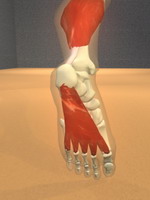 Plantar fasciitis is the most common form of chronic heel pain.
The term "plantar" (Plan"tar) refers to the sole of the
foot and the term "fasciitis" (fash"E-I'tis) refers to
inflammation of the fascia, which is the fibrous band of tissue
that connects the heel bone to the toes. The plantar fascia makes
up the arch on the bottom of your foot and acts to absorb shock
and propel the foot forward. The location of heel pain from plantar
fasciitis is usually at the front part of the heel but can be anywhere
along the arch of the foot. The pain results from small tears, called
microtears, in the fibers of the fascia. The microtears will
often heal partially during the night and become re-injured in the
morning when getting out of bed. Continual re-injury results
in acute pain in the heel. Microtears in the plantar fascia may
or may not be accompanied by discernable swelling.
Plantar fasciitis is the most common form of chronic heel pain.
The term "plantar" (Plan"tar) refers to the sole of the
foot and the term "fasciitis" (fash"E-I'tis) refers to
inflammation of the fascia, which is the fibrous band of tissue
that connects the heel bone to the toes. The plantar fascia makes
up the arch on the bottom of your foot and acts to absorb shock
and propel the foot forward. The location of heel pain from plantar
fasciitis is usually at the front part of the heel but can be anywhere
along the arch of the foot. The pain results from small tears, called
microtears, in the fibers of the fascia. The microtears will
often heal partially during the night and become re-injured in the
morning when getting out of bed. Continual re-injury results
in acute pain in the heel. Microtears in the plantar fascia may
or may not be accompanied by discernable swelling.
Causes
Plantar fasciitis results
from overstress of the plantar fascia tissue. There are certain
activities and habits that can increase the risk of getting the
condition. They include:
- High impact sports such as basketball, tennis and volleyball.
- Repetitive stress sports, such as running or step aerobics.
- Sudden changes in activity level, for example, beginning
a new exercise program or a sudden increase in training
volume or intensity.
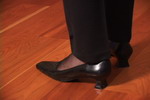
- Wearing shoes with little or no support - especially if you
have flat feet or feet with high arches.
- Occupations that require a significant amount of time
standing or walking, for example, police work, postal delivery,
teaching and flight attendance.
- Being overweight. You are considered overweight if you have a
Body Mass Index (BMI) over 25.
- Having tight hamstring and calf muscles, which is often genetic but can
be improved with stretching.
|
 |
 |
 Symptoms and Diagnosis
Heel pain caused by plantar
fasciitis is usually intermittent, meaning it can appear and disappear
over time. Those who suffer from plantar fasciitis often experience
sharp pain in their heel with the first steps in the morning, after
long periods of sitting or being on their feet, and after exercise.
Although plantar fasciitis is the most common cause of chronic heel
pain, there are other more serious ailments that can cause heel pain.
It is important to visit a licensed healthcare provider, such as a
podiatrist, orthopedic physician or family doctor, to obtain a diagnosis
before beginning treatment for plantar fasciitis. The provider will
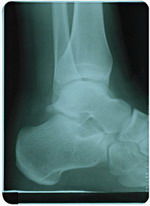
conduct a physical examination and often order an x-ray or a bone scan
to confirm the diagnosis.
Treatment
Once a healthcare provider diagnoses you as having plantar fasciitis,
it is important to begin treatment as soon as possible. Conservative
treatments for plantar fasciitis have a high success rate. Most people
see a reduction in pain within six weeks, but eliminating the problem
completely may take as long as one year. Studies have shown that the
longer the patient waits to treat the plantar fasciitis, the harder it
will be to eliminate.
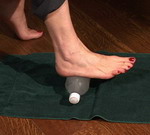 Most doctors recommend conservative treatments such as rest, icing,
massage, stretching, taping the foot, orthotics, supportive shoes,
non-steroidal anti-inflammatory medications and night splints. If
conservative treatments fail, a health care provider may recommend
other procedures such as walking casts or Extracorporeal Shockwave
Therapy (ESWT). In some severe cases, more invasive treatments
such as corticosteroid injections or surgery may be considered.
Most doctors recommend conservative treatments such as rest, icing,
massage, stretching, taping the foot, orthotics, supportive shoes,
non-steroidal anti-inflammatory medications and night splints. If
conservative treatments fail, a health care provider may recommend
other procedures such as walking casts or Extracorporeal Shockwave
Therapy (ESWT). In some severe cases, more invasive treatments
such as corticosteroid injections or surgery may be considered.
Heeling Solutions R.E.S.C.U.E. Program™for Plantar Fasciitis
The Heeling Solutions R.E.S.C.U.E. Program™ provides you with a
comprehensive view of the causes of plantar fasciitis and demonstrates
medically proven techniques to eliminate the pain. You can customize your
treatment plan based upon your condition and the advice of a healthcare
provider.
|